Wednesday, September 28, 2016

                                                                   Agitprop 


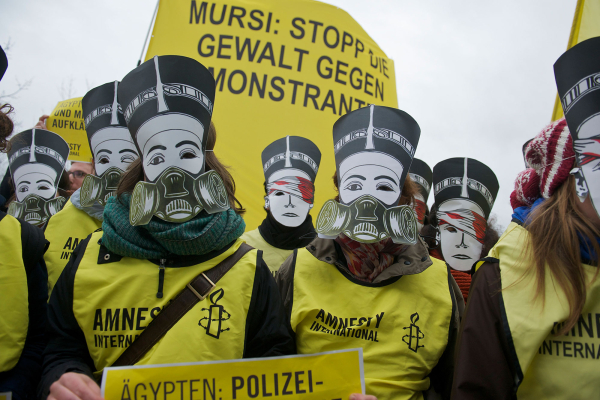
                                 Amnesty International (founded 1961, active worldwide) in collaboration with El Zeft (Egyptian, birthdate unknown). Action against the excessive use of force by Egyptian police against protesters, on the occasion of Mohammed Morsi's state visit outside the Bundeskanzleramt/Paul-Löbe-Haus, Berlin, Germany, January 30, 2013. Documentary photograph. © Amnesty lnternational/EI Zeft

El Zeft’s stencil of a riot-ready Queen Nefertiti first appeared on Cairo streets in 2012, as, in his words, "a tribute to all women in our beloved Revolution." When Amnesty International initiated a global campaign to address mounting human rights violations in Egypt, their German section partnered with El Zeft to make this their symbol. Amnesty activists wrote thousands of letters to the Egyptian authorities and president, circulated petitions, held protest marches with self-made Nefertiti banners, and wore bloodied masks using the image. Based on a famous statue in Berlin’s Neues Museum, El Zeft’s updated icon helped to build media attention and worldwide pressure.
https://www.brooklynmuseum.org/exhibitions/agitprop
  
Century of self relates to advertising and how it affects people differently. Big company's uses woman insecurity and men pride to there advantages so they can buy the company's products.This picture shows me that even at bad times like a protest rally big company's can still benefits from it. Every one is wearing a similar mask that some one else made witch gave his or her company a higher profit  That moment. All though protest is a form of rebelling someone else always benefits from a person lost.

              
The Trayvon martin movement is a prime example of big company's benefiting from a protest


Agitprop assignment

Founded on Slavery and Genocide, performance still 1, pigment print, 22x30 inches, 2014
the first project I choose was from an artist known as Dread Scott. The exhibition is called "On the Impossibility of Freedom in a Country Founded on Slavery and Genocide". its a performance that speaks on the oppression of African Americans and how they have been fighting this long for almost nothing. I chose this performance because it speaks out on a problem that has been on going for many years. even in todays society, we have the same problems with many young African Americans getting shot and killed by police officers, with the victim doing little to nothing to cause gun fire.


Moneta Sleet Jr. (American, 1926–1996). Rosa Parks, Dr. and Mrs. Abernathy, Dr. Ralph Bunche, and Dr. and Mrs. Martin Luther King, Jr. leading marchers into Montgomery, 1965, printed circa 1970. Gelatin silver print, 133⁄8 x 10³⁄4 in. (34 × 27.3 cm). Saint Louis Art Museum, Gift of the Johnson Publishing Company, 426:1991. © Johnson Publishing Company, LLC
I chose this movement called "Witness: Art and Civil Rights in the Sixties" taken by Moneta Sleet Jr. it was taken during the civil rights movement in 1964. this protest stood out to me because it shows the unity not only between the African American community, but as well as Caucasians joining in the fight to stop oppression and make everyone equal.


Both of these protests speak on what is going on in todays world. even though in todays society everything is considered to be "equal" amongst the Caucasian and African American race, there is still an incredible amount of racism and discrimination going on. It is a great thing to see that people like Dread Scott are not afraid to express their feelings and stand up for the people of their race.      https://www.brooklynmuseum.org/exhibitions/witness_civil_rights/

International Working Women's Day Is the Fighting Day of the Proletariat

International Working Women's Day Is the Fighting Day of the Proletariat is a piece of art that is reflective of both women's stuggles in current society in their attempts to join the work force. It finds it's chance of showing women's strenght by portraying a woman as a leader in the revolution and essentially promising women that this revolution, which the artist feels is continuing today will bring about the changes that women want.

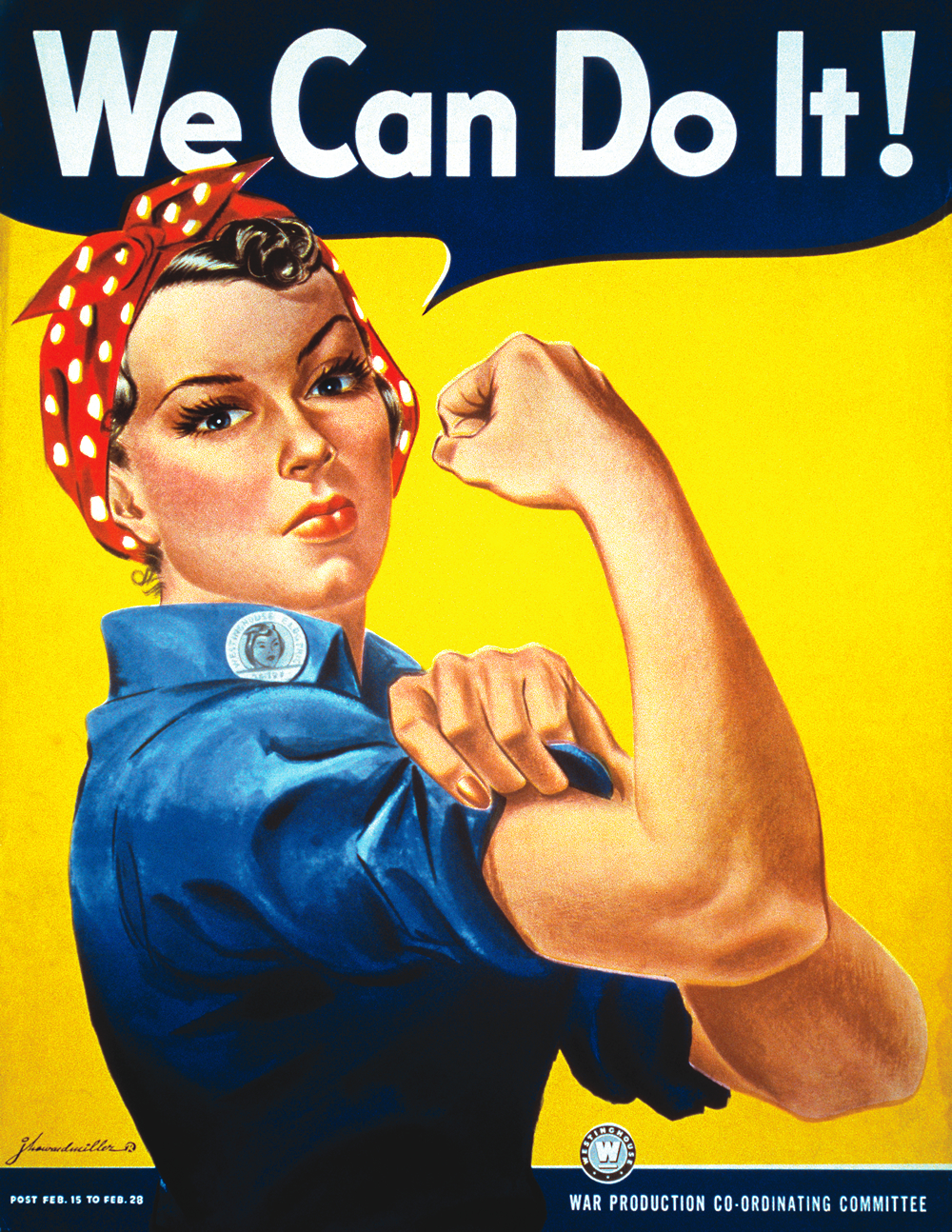
In a similar fashion the We Can Do It! was also empowering to women telling them that they too have a role to play in the war with Japan. The poster was actually meant to also be placed in factories rather than in civilian hubs to help boost America's factory workers' morale. Both factory workers and women would go on to contribute strongly to America's victory over Japan and Germany.

Both of these images are striking and empower women to become involved in something great, whether it be a Revolution or just helping their homeland in it's time of need. One was produced by an artist to spark a feelings of being discontent and desire to take on more politically and physically aggressive roles, while the other was more about motivating the women who largely have already taken over the man's place in the workplace since the men are off fighting a war.

The title of the We Can Do It! was changed later on when it was rediscovered for feminist purposes to Rosie the Riveter. Riveter being the assumed job of the central character "Rosie". Riveter in particular takes on a position of supplying the American troops. Rivets were a key part of many different American war vehicles including: tanks, airplanes and boats.

In the same way that Rosie the Riveter was rediscovered and re purposed so was International Working Women's Day Is the Fighting Day of the Proletariat since the piece was made a decade after the revolution technically ended. The two pieces share an agenda and go about achieving their goals in a similar fashion.

Agitprop

Tuesday, September 27, 2016

Agitprop:The Similarities Between Two Artists

                                  The Mindset of the Like Mind
                                         Samantha Garcia
         Gran Fury is an activist art collective that rose during the mid-1980's that focused on stirring up emotions people have towards AIDS. They use techniques of advertising with information and outrage to get the message out.  This is how they educate and motivate the general public. The piece "Women Don't Get AIDS" was one chosen from Agitprop's Exhibition and its slogan was to get people thinking about women and the fact that they do get AIDS and they do get sick and they do die. AIDS isn't discriminatory. It isn't choosy. Men or women can get it and that is what Gran Fury is all about. 
Another piece to look at is Jenny Holzer’s The Living Series: You Can Make Yourself Enter Somewhere.  For her it was what she said that made an impact. Both pieces are not the same though they share similarities. Holzer’s piece is something to take on a more personal level. While both are meant to raise awareness, Gran Fury does so through advertisement and Holzer does so through a poetic sort of speech. One is about being aware of real life events that are happening around us, while the other is more about what is happening within us. 
Holzer once said that for her work, "The anonymity was critical. I wanted people to consider the ideas but not give more than passing thought to who produced them." In her mind it wasn’t as much about why she wrote her pieces or created them, she just wanted a reaction. It was the work that spoke for itself. 
       
        The same can be said about Gran Fury. It was about the reaction of the crowd that mattered. It wasn’t just about who was saying it, it was about the why. Both artist intentions were to reach people on an entirely new level. It was a get-in-your face type of level.
Between the two, I enjoy Holzer’s. I like the way she is so straight forward and frank. I wouldn’t call it poetry because it doesn’t feel like it but it seems like it.  She intends to "generate debate and make us think critically. A political activist as well as an artist, Holzer's aim is to disrupt the passive reception of information from damaging sources." 

Agitprop: Art & Race

There were many projects presented in the AGITPROP Exhibition that had powerful meanings, but the one that caught my attention the most was the piece by Dread Scott. The piece by Dread Scott was titled "On the Impossibility of Freedom in a Country Founded on Slavery and Genocide". This performance piece was only performed once in 2014. Scott's piece was used to show the concept of "the struggle for freedom", which referenced the Civil Rights struggle faced in Birmingham Alabama. Dread Scott decided to reenact what had happened that time when the government used high-powered water hoses to hose down non-violent protestors. In order to reenact this brutality and struggle, Scott decided to attempt to walk into the strong jet of water to create a metaphor comparing the resistance of an individual and the actions of a violent protestor.

There are many protestors and activists who would applaud Dread Scott for his powerful piece, but there are also other art pieces that also shine a light on racial issues. Another art piece that caught my attention after reading about Scott's piece is that of Nate Hill. Like Dread Scott, Nate Hill is also an African American man who has done pieces based on racial issues. Hill's piece is titled "The White Ambassador", which was performed for about three times a week ending on February of 2012. Hill's piece focused on racism towards whites by blacks. The piece consisted of Nate Hill walking in the streets of Harlem, New York in whiteface, wearing a sign that read "White People DO NOT Smell Like Wet Dog" while chanting "We are white! We smell alright!". Nate Hills claims that this piece was entitled as an effort to tackle racist attitudes, and to prove that racism can go in any direction not only towards African Americans.

These two performance art pieces share a few things in common, which would explain why I chose to write about them. Both pieces involve racial issues that can easily be seen based on the actions of the artists. Dread Scott and Nate Hills use racial symbolism that provides their audience with insight about the theme of their work. They both share the theme of incorporating racial issues with a physical performance. Along with these physical performances, they both play a role that reverses the issues they are trying to expose. Scott reverses the situation of the water hoses by voluntarily walking towards it instead of being brought down. Hill reverses the idea of who is racist, by flipping the idea of "blackface" and using "whiteface" to show that black people can also be racist along with other races. Therefore, they both protest related and both focus on a single theme which includes racial issues. 


Although they might have similarities they do have their differences. One of these differences being that one piece focuses more on one race while the other reaches out for another. Dread Scott's piece tends to focus more on just how African Americans were treated, but Nate Hill focuses on the racial relationship between African Americans, white people, and other races in terms of who can be racist. These two performances both deliver a powerful message to their audiences. Even if it is a staged performance like that of Dread Scott's or more of a spontaneous performance like Hill's, they both reach the audience in their own way. In all, these two performance art pieces create one single form of activism to raise awareness of racial issues. 


Agitprop

     Rachel George
      Tina Modotti, Italian artist, is born in Udine in Italy in 1896. Modotti fascination in the arts led her to theatrical interest. She was also a beauteous woman and was able to meet a photographer name  Edward Weston. Modotti's structure was model-like so she modeled for him. During this time, Mexico's politics is on a rise and so is Modotti's interest in politics. Photography is not just pictures to  her, it is one way of displaying issues occurring at the time.
        Images is one of the best ways to seek a revolution. Tina Modotti use photos of women and laborious workers and their hands. Also by joining the Communist party and El Machete, a group that speaks on problems in Mexico. One of her photographs is Woman with Flag dated in 1928. This picture reveals how women can be involve in politics.
        Lady Liberty is a prime example of women in politics. According to National Park Service, the torch she holds in her hand denotes enlightenment. It's implicit meaning tells us that the torch lighting is liberty and human rights. I believe that it also symbolizes woman power.
        Both images symbolizes freedom. One picture shows a woman holding a flag. The other picture shows a woman standing tall holding a torch. The themes are different; Modotti's picture is politics; Lady Liberty's theme is politics.

Agitprop Exhibitions

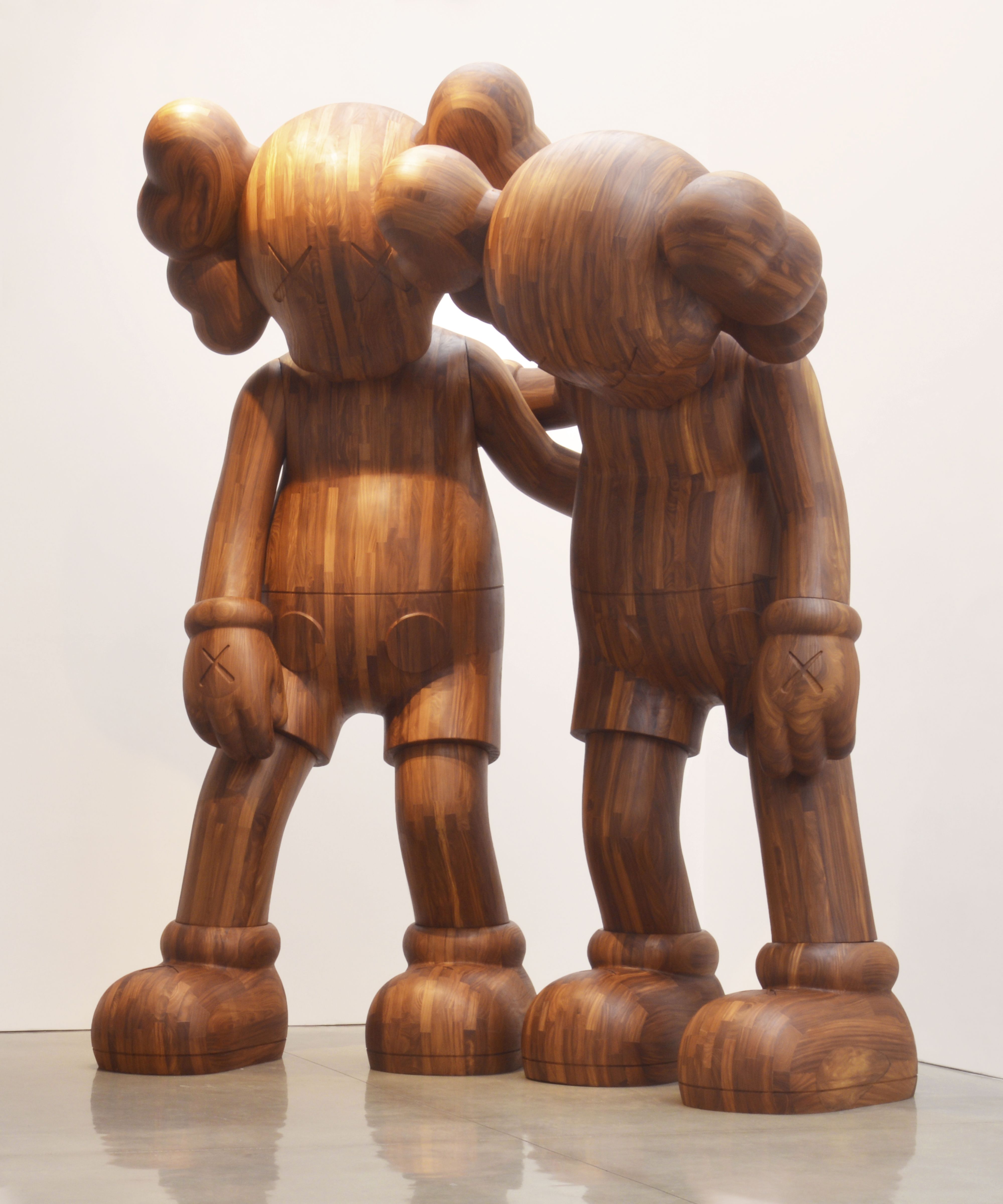
The first exhibition that I chose to talk about its the KAWS : "Along The Way"https://www.brooklynmuseum.org/exhibitions/kaws_along_the_way exhibition. The piece was open from June 10th to March 27th 2016. The reason I chose this exhibition is because I am familiar with KAWS and the art he does as in fashion. It caught my eye also due to the fact of the such large scale, it is 18 feet high and all wood. Both of the big creatures, which are said to look like childhood toys or cartoon characters, have their heads both looking down and arms around each other for comfort. They look to be helping each other.

 In my opinion, the piece by KAWS represents something more than just two figures and i am sure can be perceived in many ways. The way I see it as is two friends growing old together and only having them left to each other. Due to the name of the piece, "Along The Way", I strongly feel it is about loosing people along the way and only having one person by your side. For my second exhibition i chose one named "A World Not Ours"http://myartguides.com/exhibitions/a-world-not-ours/ which is directed by The Schwart's Foundation. It is shown off in Foundation's venue in Greece, Art Space Pythagorian.


    This exhibition sets out to talk about and inform viewers about forced migration and refugee crisis from the standpoint of artists,photographers, filmmakers and activists. The refugee crisis began in 2015 and it brought migrants, mostly from Syria, seeking better life. They traveled across the Mediterranean, due to travel the rate of death at sea rose tremendously. In my opinion both of these exhibition actually has some stuff in common, it is just hidden and you must use your imagination.


To me, although they do not nearly mean the same thing, or have the same message, stuff can be taken out of both to put together. During these refugee migrations people were often homeless, jobless, and only left to be with the people they migrated with, maybe people who they lived with back in the countries they came from. I am sure in times they have been bent over try to comfort each other as the figures are in KAWS' piece. The only way to make it through tough situations in my opinion is to remember the people close to you and seek comfort and guidance from them. In conclusion live with no path can be hard to tackle, which is why sometime you just need to seek for help from friends and loved ones.